I guess, it was “written” that I would become a professor of tourism, specializing on management of natural resources and tourism impacts in remote areas. I find it rather interesting how early encounters with wildlife shape future careers. The curiosity about places other than my own hometown planted in me a seed for my future adventures, some of which were utterly reckless. Encounters with wildlife also started with a bizarre set of events. As I wrote in a previous posting, I am really afraid of snakes. I am curious about snakes, thrilled to see it crawling (this makes hair on my spine stand up!), but will not go closer even if it is dead. My mom tells me that when I was a two-month old baby, she had taken me to Khajuri where all kinds of venomous snakes crawled around. King Cobras were common; I am fortunate not to have seen it in the wild. I have seen big Dhamans (Ptyas mucosus) on the banks of Devata Pokhari. So my mom puts me on bed for an afternoon nap. My grandparent’s house in Khajuri consisted of two modest buildings. The walls were made of a reed-mud combination and the roof had cylindrical-shaped tiles. The two buildings were separated by a courtyard in the middle and gardens on the sides. It was a custom in the village to spend the afternoon mostly in the verandah or the courtyard because it would get terribly hot during summer. Anyway, I was sleeping on a make-shift bed on the ground. All of a sudden, there was a big snake underneath my bed. Everybody was panicking and did not know what to do, no one dared to come close to me. So there I was surrounded by a big snake, and I could do nothing about it (my mom told me that I was sound asleep). Fortunately, the snake slithered away after sometime and everybody rejoiced that nothing bad happened to me. May be snake phobia is in my genes, as I know that my mom and I react exactly the same way whenever we see a snake.
Thus, encounters with wildlife were something that came natural to me. Chitwan in the late 60s and early 70s was pretty much a wild place. People had this notion that there were more wild things in Chitwan than people. Our house in Chitwan back then was very rudimentary, made mostly of wood and thatch grasses. This was a temporary house as most of our family members (except my uncle) lived in Kathmandu. My dad was temporarily assigned to Chitwan. The year must have been 1973. I remember when I was 11 we had a bad incident in our homestead in Chitwan. Back then, we used to keep many chickens (around 200) and we had two pairs of goats, one pair was skinny than the other. One night, my dad saw a pair of glowing eyes in the dark as he went out to relieve himself. He did not know what exactly the animal was but the following morning we found that a pair of goats was missing from the corral. The whole family went out to search for the missing goats, and lo and behold!, we found the mother goat lying dead in the field. She had been blood-sucked dry and there was a fatal mark around her neck. The kid goat was nowhere to be found. Later in the afternoon, my uncle found its head at the edge of our field (the edge marks the boundaries between our land and the Barandabar forest). Villagers gathered in our house concluded that it must have been the clouded leopard (Neofelis nebulosa) who had snatched away the goats. There were also rumours about witchcraft, but it seemed to us that the culprit in this case was not a poor woman in the village but a nasty leopard. The leopard must have been really smart as he chose the two healthy (fat) ones and not the skinny ones; they were left untouched, they seemed very sacred though. This was my earliest exposure to human-wildlife conflict in Chitwan, a topic which would become one of my major research themes in my future academic career. I would come back to this issue ten years later as an academic researcher.
Monday, August 10, 2009


Saturday, August 8, 2009
Way to Paradise
Well, it was not just Thamel that was changing fast. The whole country was experiencing change. I had some first hand insights to some of these changes that were going on outside the capital city.
By now, you must have figured out that I spent my formative years mostly with my grandparents. My dad was a government employee (department of Agriculture) and he was stationed outside the valley, so my mother had to accompany him wherever my dad’s job took him. In the late 60s, my dad worked for the Rapti Valley Resettlement Project in Nawalpur (Nawal Parasi District) in the Terai. There were no roads to Chitwan (a neighboring district on the western edge of the Narayani River). From Kathmandu, the ride involved taking the bus to Hetaunda (a small market town about 100 km south of the Valley) via the Tribhuvan Highway (Kathmandu-Birgunj), then taking the bus (I am not sure if a regular bus service existed then) on the dirt road to Narayan Ghat, then taking the ferry across the Narayani River, switch to another bus and continue further toward Parasi. I have vague recollections of my first road trip outside the Valley. My previous visit to Janakpur was on an airplane flight of which I remember nothing.
Anyway, it so happened that my father’s officemate was in Kathmandu for a visit to the Department of Agriculture. As he had traveled from Nawalpur on an official car, my parents had requested that he visit our house in Paknajole, and take me with him to Nawalpur if my grandfather granted his approval. So this offical (and I suppose the driver) came to our house, talked to my grandparents who asked me to be ready for this very long journey to the Terai. It must have been hard for my grandfather to let me go as he did not have a strong liking of places outside Kathmandu and he certainly did not like the malaria-infested (which had been eradicated in the 50s) hot tropical lowlands. Anyway, we were soon on the road to Chitwan. I was very excited about this trip, not only was I looking forward to meeting my parents after a long time, but I was also very curious about the road journey and the new places that I would be seeing. As a three year old boy, I had enjoyed my trip to Janakpur. This time I was older (7 years old) and was ready for the adventure. I was given two tablets to drink lest I fall sick on the road. I don’t remember much after that. What I do remember is that the road from Hetaunda to Narayan Ghat was basically a dirt road, and could be travelled only on a four wheel drive like the ones we were riding. It was already dark by the time we reached Hetaunda. The Tribhuvan Highway is a treacherous road, rising up and down the valley with numerous hairpin curves and then reaching to a height of nearly 8,000 ft above sea level at Sim Bhanjyang (almost a mid-point between Kathmandu and Hetaunda; on a clear day it is possible to see the summit of Mt. Everest from Daman, the hill below Sim Bhanjyang). The journey was scary but fun.
It all felt very strange once we hit the road from Hetaunda toward Chitwan. Chitwan, as a physical location does not exist, it is a District and not a town or a village. But people made frequent references to Chitwan and not Naraya Ghat or Bharatpur where the district headquarter is located. Anyway, the jeep was traveling on a dirt track which was hardly wider than ten feet. There were trees and stumps all over the place, so the driver had to carefully navigate the jeep through the jungle. We had to cross numerous ravines and rivers. Chitwan was still densely forested (it is the home of the famous Chitwan National Park and the Tikauli (Barandabar) forest), punctuated by small hamlets dotted by thatch-roofed huts. I remember vividly that the driver would draw our attention to the glowing eyes in the dark (I learnt later that they were the eyes of sambar deer (Axis axis), and howls of wild animals. Chitwan was, and still is, famous for tigers, rhinoceros, crocodiles and other big-game mammals, so I was thrilled (honestly, I was afraid) to be on the road. We came to our stop for the night somewhere in the middle of the jungle (I think it was Bharatpur but I am not sure about it). The following morning we went down to the river at Narayan Ghat, which back then was mostly a collection of thatch-roofed houses. I do not remember seeing a concrete house, or may be I just did not see that part of the town. Anyway, our jeep was loaded on to the ferry boat. The interesting this about the ferry was two boats (timber construction) were tied together to make them wide enough to load vehicles. The river was big; I had not seen anything like that before. The view was just marvelous. So we were on the boat and a few minutes after we were on the Nawal Parasi side of the river. The jeep was unloaded, and after crossing a shallow section of the river we were back on the dirt road. I don’t remember how or what time did we arrive at Nawalpur. What I remember is that from a hill top (Daunne Danda), one could see the Narayani river below and its numerous sandbanks; the view toward Chitwan was just magnificent – it was densely packed with tall trees (mostly Sal (Shorea robusta)). Nearby, I could see the dense undergrowth, tall trees of all shapes and forms, and numerous climbers and creepers hanging on to the trees.
This journey had left a vivid impression on me. Here I was, a seven year old boy from the city, partaking in an adventurous, occasionally hair-raising, jeep ride through one of the last vestiges of pristine forests in the country. The scenery everywhere was wild and beautiful, the road interrupted by numerous clear-bottom streams in which little fish swam peacefully, the air crisp but humid, the cries from the wild strange and mysterious. This was in total contrast to what I was used to in the city. I thought I was in paradise!
Thursday, August 6, 2009
Paradise Lost
I remember how Thamel used to be in the late 60s and early 70s. The first ever school that I attended was the venerable Juddhodaya Public High School. Popularly, and affectionately, known as JP, it was a public school in the afternoon but was a private English school in the morning. The English school was run by a very strict but highly effective principal whose first name I do not remember very well. I do remember he was a Gurung man. His wife was very active too and their two sons were also enrolled at the same school. I started in Grade 5 (I was eight years old at that time) – the year must have been 1970. There were three different routes to the school, a short route via Thamel (past the Kathmandu Guest House), a longer route via Chetrapati, and another longer route via Sorahkhutte. The route we would select would depend on my friends who would be walking with me to the school; mind you, I was the youngest in class. We had to be inside the school compound by 6 am in the morning, too early for an eight year old, however, I was already used to waking up early in the morning (five to be exact). So, I would (or it was rather my grandmother) pack my bags and walk toward the school, a few boys would be either waiting for me down the street or would catch up in case they were late. One of my classmates, Chandra Gurung (I affectionately called him Chandre), was slightly older than me, perhaps by two years. He lived in a rented apartment in Sorahkhutte, so I used to call him up from the street. We then would walk to the school together via Thamel. Sometimes, he would come early, call me up in my house, and then we would go to school via Chetrapati. The shorter route to the school was via Saat Ghumti (street with seven corners), which was behind KGH, but unless we were really late we would never go that way. The main reason was that Saat Ghumti always seemed narrow (it was not on the main street) and dark (no pole lights), and our elders would advise us little children to take a safer route instead. We used to take that route occasionally, usually when we were going to be late to school. We would rather take the risk of walking the dark street than being late to school, in case of which we were certain to receive some form of punishment. So, we would run past Saat Ghumti (occasionally looking behind if someone was following), walk briskly past the (east) entrance to KGH, and then slow down a bit to come to our senses, celebrate our victory of overcoming fear, and then calmly walk past the school entrance.
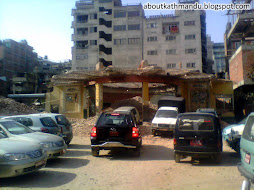
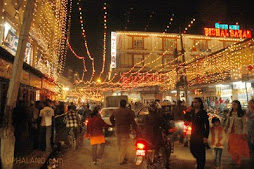
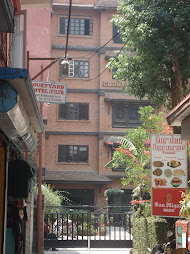
Today when I think about those days, especially the dreaded walk past Saat Ghumti and the fear of being chased by some hooligans or an imaginary ghost (we had heard plenty of ghost stories), I am forced to laugh at myself and my foolish friends. What a chicken we had been! But would you really blame an eight year old for being a chicken, you won’t, right? Anyway, the point is Thamel of the past was not what it has become today, a real world for the tourists, a fantasy land for the locals, with all its neon lights, foreigners and foreign food, departmental stores, clubs, and what not. More on this will come later. For now, let’s stay focused on land use change in and around Thamel. Two popular hotels – Manang at the northern edge of Thamel (toward Sorahkhutte Pati) and Marsyangdi, a few blocks north of KGH – were built by entrepreneurs from Manang (a hill district in the shadow of the Great Himalaya in central Nepal). They purchased the vacant land from people I knew. By the way, Sorahkhutte means sixteen legged, and pati means a shelter (more like a pavilion). There is an interesting story of such patis in the Valley. The patis were the inns of yesteryears . The Z Street, which today connects Thamel with Paknajole, used to be the vegetable garden where we stomped. A big white-washed residence in Thamel, which belonged to a Thakali family who had extensive properties around the country including in Chitwan, is now gone. Today, it is replaced by a collection of buildings outfitted with restaurants, retail shops, bank, travel and trekking agency, cargo agent, etc. A big compound northeast from Thakali’s residence has now a hotel in it (Hotel Vaishali). I had a friend in school (he was a couple grades higher than me) who lived in a house inside that compound. The land owned by our neighbors in Paknajole – the Thakuri family – now has several hotels, a spa, a restaurant and other businesses. There are hotels and restaurants of all kinds and names everywhere. And there is the Cheap Heaven Restaurant!. I wonder what kind of heaven is the owner selling. To me, the paradise as it used to exist, has been lost already. The green space that I saw, experienced, felt, touched and played upon has long since been gone. There are concrete buildings and neon lights everywhere, and new billboards have sprung up as if to proclaim the seasons'offerings of bits of paradise. Thamel has become the land of excess and absurdities, where Buddha can be cool and funky!
To be continued...
Tuesday, August 4, 2009
Paving Paradise
My recent visit to Kathmandu evoked many memorable events from the past. I was in Montreal in September 1994 attending a global conference on tourism. I met a guy from New York who had been to Nepal in the 70s and had loved visiting there. He remembered his visit to Pashupatinath Temple and told me that he had discovered “paradise on earth”. I will tell you that during the 70s Nepal was a very popular destination for the hippies; maurijauna (ganza in Nepali), cannabis (hashish) were readily available in tourist areas such as the infamous “Freak Street” (Jhonche Tole). My friend from New York probably had smoked some ganza (resident Sadhus in Pashupati smoked it openly) as he must have felt the smoke lifting him to cloud nine. Local newspapers would report widespread use of other potent drugs like crack cocaine, heroin, and LSD (Lysergic Acid Diethylamide) amongst tourists and locals mostly who associated with tourists. Movies capitalized on the drug culture. I remember watching the movie “LSD” (not sure about the country where this was made) at a local theater. Dev Anand (the Gary Cooper of Bollywood) made a very popular movie “Hare Rama Hare Krishna” which was entirely filmed in tourist locations in Kathmandu. So, if you liked joints and grew up in the 70s and visited Kathmandu, I bet you felt there was no better place on earth.
However, the point of this post is not to dwell on the drug culture of Kathmandu but to talk about the loss of open space in and around my neighborhood. As I wrote in my previous blog, my friends and I would fool around and engage in all kinds of mischiefs. Stealing plums and persimmons from neighbor’s orchards, marauding vegetable gardens looking for the best radish (long and red – I haven’t seen this variety outside Kathmandu) and succulent cucumbers to eat while we played, were our favorite pass times . As Jhonche was getting notorious for its drug-infested tourist culture, Thamel (which was only a block or two away from our house in Paknajole) was gradually prospering as a tourist center. The legendary Kathmandu Guest House (KGH), run by the Shakya family, was the oldest establishment in Thamel. Two restaurants – Utse (Tibetan food, my favorite restaurant as I grew older) and KC’s (mostly western fares) - were the oldest restaurants in Thamel. But as the 70s waned, Thamel saw dramatic changes in its built-up areas, newer and larger houses were built to provide tourist accommodations. The main street in Thamel leading to the KGH used to be poorly lit and deemed unsafe to walk at night (we would avoid it after six in the evening). But now with new constructions and expanding tourist establishments, orchards and vegetable gardens were slowly giving way to multi-story buildings. I used to spend hours playing with my friends in the vegetable gardens (this was tolerated during off-seasons when no vegetables were planted). Suddenly, our favorite playgrounds were off-limits to us, and our daily routines affected as we started looking for alternative venues, further away from our neighborhood. Kathmandu was certainly experiencing a construction boom and it seemed Thamel was the epicenter of that boom. Our own family garden in front of our house was lost, as we had to forego our rights to plant vegetables there due to legal disputes with our neighbors who claimed the small parcel of land as communal property. Our neighbor behind our house had a big chunk of land where the family would grow vegetables. They sold their entire property to a guy who decided to construct a hotel. Tourist developments were slowly changing the landscape around Thamel, and the sights of tourists were becoming much more frequent. It was not until about the mid-1980s that tourism really took a strong hold in Thamel. But it was long before that all vacant plots and green space succumbed to the pressures of touristic enterprise and aspirations.
More on landuse change later...
Saturday, August 1, 2009
Down the memory lane
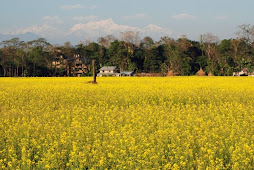
Memories are powerful things, specially those from early years of your life. Some people, like myself, cling to their childhood memories as they seek to find their roots, or their identity. Whatever is one looking for - cherished and dreaded moments - traveling down the memory lane is always fun. I like to remember the sweet times that I enjoyed, the occasional embarrassing moments that I wished never occurred, moments that I wished lingered for a little while, and so on. I still remember my days in Khajuri as a three year old boy visiting my mother’s side of the family for the first time. It was not really the first time I had visited my grandparent’s family, I was there as a two-month old baby, but this I don’t remember. So you see, memory lanes can hit a dead end. Now, some people may ask how come I remember things that happened so long ago in my life. I do not claim to remember everything, what I remember are snippets of some visual imageries. When I returned later as a 13 year old, things that I saw in Khajuri confirmed that my earlier memories were fairly accurate.
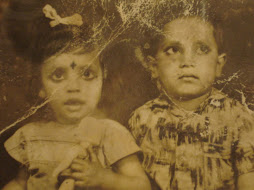
I remembered the location of my grandparent’s house (not the details of the house though). The house was perched above from a pond; a narrow path led to the stairs (brick-paved) to the pond. On top of the stairs was the southern entrance to the templeyard; access to the main temple was through a mango orchard. The pond was popularly known as Devata Pokhari (God’s Pond). Behind the house (to the east) was a big Jamun tree (Syzygium cumini), an evergreen tropical flowering tree native to Bangladesh, India, Nepal, Pakistan and Indonesia. The Jamun fruit (a small, purple colored plum) is simply delicious. These images were implanted in my memories so strongly that the ponds, temple and the tree were the three major things I was expecting to see in my future visits to Khajuri, which would occur only in 1976, more than ten years after my first visit there. Everytime I heard something about Khajuri, the first thing that came to my mind were the ponds, the Jamun tree, and the dirt path leading to my grandparents’ house. It’s interesting that the surroundings in Khajuri fascinated me. It seemed the perfect place for a kid to grow up – swimming in the ponds, eating Jamun and mangoes, kicking dirt, and living carefree. I had no memories of the train ride that we had to take from Janakpur (a town in the southern lowlands of Nepal) to Khajuri, but I do remember my mother’s attempts to cheer me and my younger sister during our photo session at a studio in Jay Nagar (a border town in India). My sister was crying, and was not cooperating with the photographer, so he gave her a small doll to hold. I don’t remember how long we spent at the studio, but he was able to take our photo (hand painted in color!). I also remember the strong smell of urine on the street on our way to my aunt’s (my mom’s eldest sister) apartment in town. Jay Nagar is at the terminus of the Indian railway. The smell of coal and steam, coupled with the southern heat, created a strange odor in the air. It did not occur to me at that time that the air we were breathing was perhaps polluted. On the contrary, I found the smell of the coal in the air to be very pleasant.
To sum up, my early memories of Khajuri consisted of 1) physical objects: ponds, trees, temples, and 2) sensory: the strong smell of urine and coal in Jay Nagar. Overall, it must have been a pleasant visit, as I always longed to return to Khajuri.
Thursday, July 30, 2009
Back to the River
I have been absent for a while – two international travels and several other things have kept me from resuming the blog.
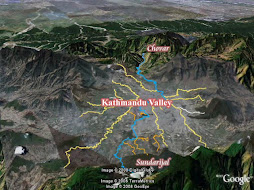
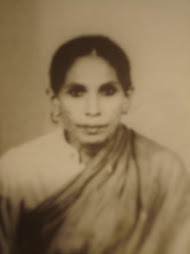
Anyway, I want to continue the “river” theme. As I said in my previous postings, the rivers of Kathmandu have been the sources of my personal exposure to Kathmandu’s natural and cultural heritage. My grandmother, who passed away when I was almost 14 (the year was 1976), was cremated on the banks of Bagmati River at Raj Rajeswori Ghat (Ghat refers to the riverbank) As part of the Hindu rituals of mourning, my father and uncle (my father’s younger brother) spent 13 days at the Ghat. Since they had to stay away from others (we could not touch them, they could not touch us) as they were deemed to be in a state of impurity, my grandfather and I visited them daily from our house in Paknajole. The dam on the river right in front of the Raj Rajeswori Ghat made swimming on the river fun. The water was deep and relatively clean, to a fourteen year old boy, whose main delight in visiting my father and uncle was the opportunity to swim. It's not that I did not care about my grandmother's untimely death (she was in her early 60s), it was just something a fourteen year old could barely understand why the rituals were necessary.
I returned to the Ghat this year (May 2009; see photo - Raj Rajeswori Ghat is seen on the far left), and was saddened to notice what a difference 30 plus years of negligence had made to the river. The river was almost dry. Some Rhesus monkeys (Macaca mulatta) were frolicking around and taking dips in shallow pools of dirty water. The poor state of the monkeys was unpleasant to the eyes. They were certainly a health hazard to people. A body was being cremated at the Ghat. I looked away painfully, and glanced toward the Pashupatinath temple, as if to seek some comfort from the sights and sounds coming from the templeyard. People were worshipping, praying or just milling around. Some tourists were talking to their guide who looked as if he was trying to explain to his guests the daily life and death ritual of his countrymen. The midday glow reflected on the temple’s golden roof created a striking aura around the temple. Combined with people’s prayers, sadhus’ (yogi, or holy men) occasional cries of “Jai Sambho!” (Victory to Lord Sambho, or Pashupatinath), and constant ringing of cast-iron bells from all four directions, created an atmosphere which, I felt, was at once chaotic and peaceful. The harmony between chaos and peace was somewhat puzzling, as if it validated my belief that even in the dirtiest of dirt, one could find happiness and joy. The joy I had as a child swimming in the river, running barefoot amidst vegetable fields and fruit orchards, and wandering around with my friends looking for mischief and collecting cigarette boxes, all could have seemed chaotic, unsightly, and reckless to others. But, who cared? I was having all the fun and the world was in my pocket, so to speak.
My thoughts were interrupted, as I heard someone wailing and crying. I looked down on the river and saw that a group of men and women were following a funeral procession. Someone in the family had died and a funeral procession had arrived at the Ghat to cremate the dead person. Several men and women were leading the procession, and were scattering rice on the path of the dead body that was carried on the shoulders of four people (most likely sons and nephews, according to Hindu rituals). The whole affair made me very sad and reminded me of life's fragility, and that in a fleet of a moment it could come to an end. I stayed there for a little longer, and then left the scene quietly. A scene like this is played out every day on the banks of the Bagmati river, considered one of the holiest rivers in Kathmandu Valley. Bagmati, for the residents of Kathmandu, had thus become the cradle and grave, and in between, a source for nourishing life and livelihood, hopes and desires, dreams and imaginations. Growing up along its bank, its sinuous shape was embedded in my youthful mind as an imaginary path to be followed (wherever it lead), and its rising and falling tides the vicissitudes of my childhood journey. A journey, which would take a three-year old boy to Khajuri, a small village near the Indo-Nepal border 20 plus kilometers from the town of Janakpur in Southern Nepal.
More about the journey in my next blog…
Subscribe to:
Posts (Atom)